The Heist of 1913: How Private Bankers Captured the U.S. Money Supply
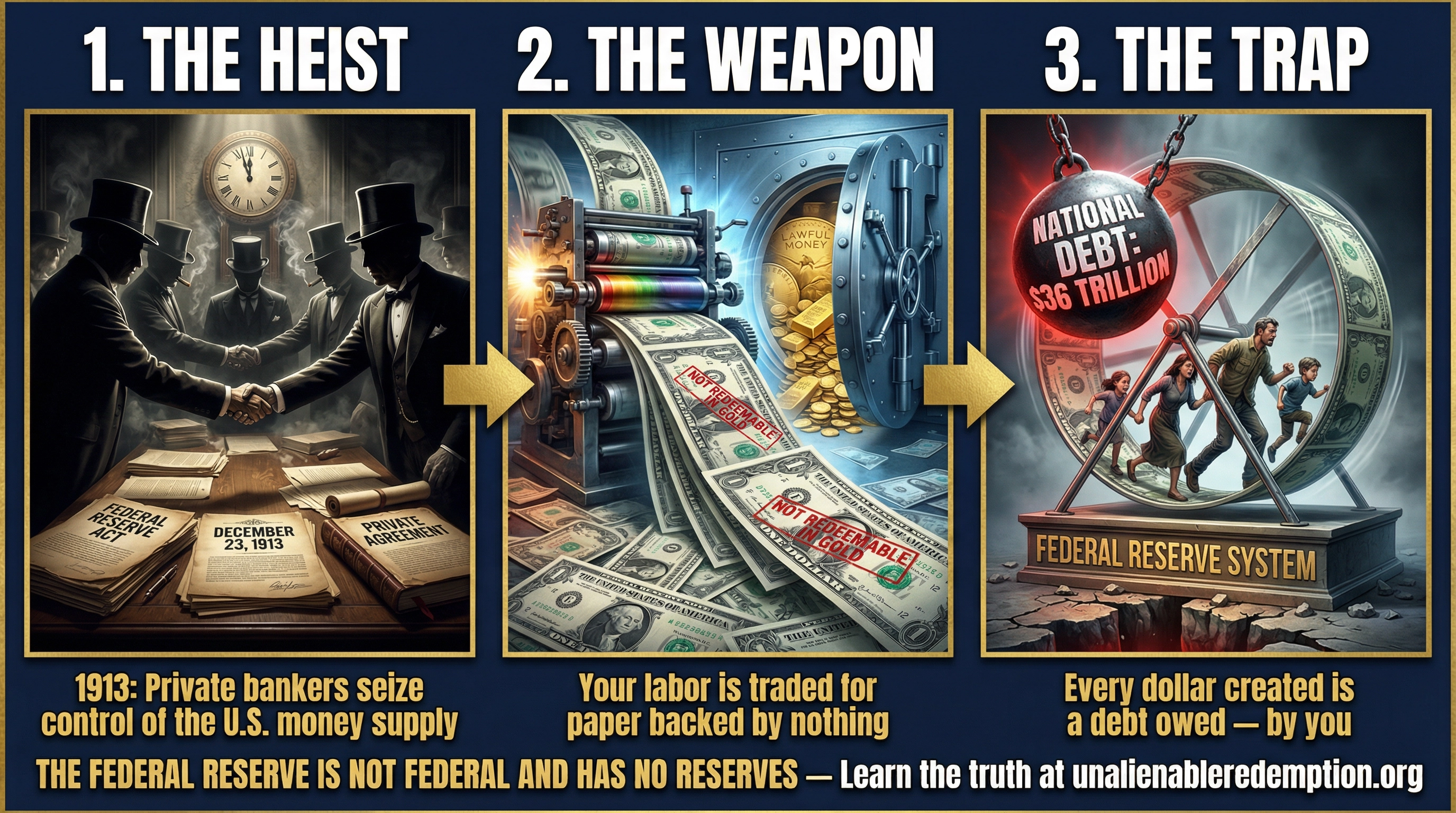
On December 23, 1913 — while most of Congress had already left for Christmas recess — a small group of senators passed the Federal Reserve Act and handed permanent control of the nation's money supply to a private banking cartel. This is not a conspiracy theory. It is documented history. And it is the root of nearly every financial burden carried by the American people today.
Constitutional Framework
Article I, Section 8, Clause 5 of the Constitution grants Congress — and Congress alone — the power "To coin Money, regulate the Value thereof." The Federal Reserve Act of 1913 did not amend the Constitution. It simply transferred that power to a private institution through statute. The transfer was unlawful from the moment it was signed.
Note: This analysis is framed exclusively through the de jure constitutional framework — the original Constitution and the Statutes at Large. It does not accept the de facto corporate banking system as a legitimate authority over the sovereign people of the Constitutional Republic.
The Setup: Jekyll Island, 1910
In November 1910, seven men boarded a private railcar in New Jersey under assumed names. Their destination was Jekyll Island, Georgia — a private resort owned by J.P. Morgan. Their mission was to draft what would become the Federal Reserve Act. The attendees represented an estimated one-quarter of the entire world's wealth: Nelson Aldrich (Senate Republican Whip and father-in-law of John D. Rockefeller Jr.), Frank Vanderlip (President of National City Bank), Henry Davison (senior partner of J.P. Morgan), Charles Norton (President of First National Bank of New York), Benjamin Strong (future first Governor of the Federal Reserve Bank of New York), and Paul Warburg (partner of Kuhn, Loeb and Company, and representative of the Rothschild banking dynasty in Europe).
These men were not public servants. They were private bankers with a direct financial interest in controlling the money supply. Their plan was straightforward: create a central bank that would appear to be a government institution while remaining privately owned and operated. The name "Federal Reserve" was deliberately chosen to obscure this reality. There is nothing federal about it, and it holds no reserves in the constitutional sense.
Frank Vanderlip later wrote in the Saturday Evening Post (February 9, 1935): "I was as secretive — indeed, as furtive — as any conspirator. Discovery, we knew, simply must not happen, or else all our time and effort would be wasted. If it were to be exposed publicly that our particular group had got together and written a banking bill, that bill would have no chance whatever of passage by Congress." The architects of the Federal Reserve admitted, in their own words, that public knowledge of their involvement would have killed the bill.
The Constitutional Violation: Article I, Section 8
The Constitution is unambiguous. Article I, Section 8, Clause 5 states that Congress shall have the power "To coin Money, regulate the Value thereof, and of foreign Coin, and fix the Standard of Weights and Measures." This power belongs to the people's elected representatives — not to private bankers, not to a board of governors appointed by those bankers, and not to a cartel of member banks whose shareholders are never publicly disclosed.
The Federal Reserve Act of 1913 (38 Stat. 251) did not amend this constitutional provision. It could not — constitutional amendments require ratification by three-fourths of the states under Article V. What Congress did instead was pass an ordinary statute purporting to delegate its constitutional monetary authority to a private institution. A statute cannot override the Constitution. Any delegation of a constitutional power that the Constitution vests exclusively in Congress is void from its inception.
Furthermore, Article I, Section 10 explicitly prohibits the states from making "any Thing but gold and silver Coin a Tender in Payment of Debts." The Federal Reserve Note — the paper currency in your wallet — is not gold, is not silver, and is not coined. It is a promissory note issued by a private bank. The shift from lawful money (gold and silver coin) to Federal Reserve Notes was completed in stages: the Gold Reserve Act of 1934 confiscated privately held gold and replaced it with Federal Reserve Notes, and the Nixon shock of 1971 severed the last link between the dollar and gold entirely.
The result is a monetary system that operates entirely outside the constitutional framework — a system in which the money supply is controlled by private interests, created as debt, and backed by nothing but the compelled acceptance of the people who are never informed of this arrangement.
Foundational History · The Construction That Built the Cage
The Federal Reserve Act Was Authorized by a Doctrine Invented in 1819
The Federal Reserve Act of 1913 delegated Congress's Article I, Section 8, Clause 5 monetary authority to a private banking cartel. That delegation required a constitutional justification — and it found one in Chief Justice John Marshall's 1819 ruling in McCulloch v. Maryland, which invented the doctrine of "implied powers": the idea that Congress can take any action "appropriate" to an enumerated end, even if not enumerated itself. Alexander Hamilton first articulated this doctrine in his 1791 bank opinion. John Taylor of Caroline rebutted it in 1820 and predicted it would produce exactly the banking cartel consolidation we see today. The Heist of 1913 is the direct downstream consequence of the Construction That Built the Cage.
Read: The Construction That Built the Cage (1791–2026) →The Weapon: How Every Dollar Is Created as Debt
The Federal Reserve Bank of Chicago published a document titled Modern Money Mechanics that explains, in plain language, how money is actually created in the United States. The document states: "The actual process of money creation takes place primarily in banks... Banks can build up deposits by increasing loans and investments... In the absence of legal reserve requirements, banks can build up deposits by increasing loans and investments so long as they keep enough currency on hand to redeem whatever amounts the holders of deposits want to convert into currency."
In plain language: banks create money by making loans. When a bank issues a mortgage, it does not lend money it already has. It creates new money — as a bookkeeping entry — and simultaneously creates a debt obligation for the borrower. The "money" lent into existence did not exist before the loan was made. The interest charged on that loan, however, was never created. This means the total debt in the system always exceeds the total money supply, making it mathematically impossible for all debts to be repaid simultaneously.
This is not a flaw in the system. It is the design of the system. A perpetual debt cycle ensures that the banking cartel maintains permanent leverage over individuals, businesses, and governments. Governments that need to fund operations must borrow from the Federal Reserve system, paying interest on money that was created from nothing. That interest is paid by taxpayers — in perpetuity.
The national debt — currently exceeding $36 trillion — is not a debt owed to the American people. It is a debt owed to the private banking system that created the money supply. Every dollar of that debt represents interest payments flowing from the productive labor of the American people to the shareholders of the Federal Reserve's member banks.
The Heist: December 23, 1913
The Federal Reserve Act was passed on December 23, 1913 — two days before Christmas. Most members of Congress had already left Washington for the holiday recess, having been assured that no further votes would be taken. The senators who remained pushed the bill through in a session that many of their colleagues did not know was occurring. President Woodrow Wilson signed it into law the same day.
Wilson later expressed profound regret. He wrote: "I am a most unhappy man. I have unwittingly ruined my country. A great industrial nation is controlled by its system of credit. Our system of credit is concentrated. The growth of the nation, therefore, and all our activities are in the hands of a few men. We have come to be one of the worst ruled, one of the most completely controlled and dominated governments in the civilized world — no longer a government by free opinion, no longer a government by conviction and the vote of the majority, but a government by the opinion and duress of a small group of dominant men."
Congressman Charles Lindbergh Sr. — father of the famous aviator — voted against the bill and warned on the floor of Congress: "This Act establishes the most gigantic trust on earth. When the President signs this bill, the invisible government by the Monetary Power will be legalized. The worst legislative crime of the ages is perpetrated by this banking and currency bill." His warning went unheeded. The heist was complete.
The Trap: What This Means for Natural Persons Today
The Federal Reserve system does not merely affect national policy. It reaches into the daily life of every natural person in the Constitutional Republic. Every mortgage, every car loan, every student loan, every credit card balance — all of these are instruments of a debt-based monetary system that was designed to keep the productive class perpetually indebted to the banking class.
The income tax — established by the 16th Amendment, ratified the same year as the Federal Reserve Act — is the collection mechanism for the interest payments. The Federal Reserve creates money as debt; the income tax ensures that a portion of every working person's labor is extracted and transferred to the banking system as interest. The two systems were designed together and operate together.
Understanding this system is not merely an academic exercise. It is the foundation for understanding why the constitutional distinction between lawful money (gold and silver coin, as specified in Article I, Section 10) and Federal Reserve Notes (debt instruments issued by a private bank) matters in practice. A natural person who understands this distinction is in a fundamentally different position than one who accepts Federal Reserve Notes as equivalent to constitutional money without question.
The ADVANCED platform at Unalienable Redemption provides the complete constitutional analysis, challenge framework, and documentation for those who wish to understand and act upon this distinction. The Federal Reserve module covers the full history, the constitutional violations, the challenge procedures, and the lawful money framework in depth.
Key Facts Every American Should Know
The Federal Reserve Is Private
The Federal Reserve is not a government agency. Its member banks are privately owned. Its shareholders are never publicly disclosed. It operates outside congressional oversight in its core monetary functions.
Every Dollar Is a Debt
Federal Reserve Notes are not money in the constitutional sense. They are promissory notes — instruments of debt. When a bank makes a loan, it creates the principal but not the interest, ensuring perpetual debt.
Gold Was Confiscated
Executive Order 6102 (1933) made it a crime for Americans to own gold. The Gold Reserve Act (1934) transferred all gold to the Federal Reserve. Lawful money was replaced with debt instruments by executive fiat.
The Constitution Was Not Amended
Article I, Section 8, Clause 5 still vests monetary authority in Congress. The Federal Reserve Act is an ordinary statute — it cannot override the Constitution. The delegation of monetary power to a private bank is void.
Spread the Truth
Share This With Everyone You Know
Most people have never been told that the Federal Reserve is a private banking cartel. Help change that.
Go Deeper: The Federal Reserve ADVANCED Module
The ADVANCED platform provides the complete constitutional analysis, challenge framework, lawful money documentation, and discovery procedures for those ready to act on this knowledge.
Related Reading
The 1886 Corporate Personhood Fraud
How a court reporter's fraudulent headnote gave corporations the rights of natural persons — and enabled Citizens United.
Your Birth Certificate Is a Stock Certificate
How the birth registration system converts natural persons into corporate entities and pledges them as collateral for the national debt.
The Three-Tier Enforcement Chain
How the Fourth Amendment, the Civil Rights Act of 1866, and a constitutional cease-and-desist notice create an enforceable remedy for rights violations.