The 1886 Corporate Personhood Fraud Explained
Corporations have been legal entities in American law since the founding era. However, in 1886, a court reporter's fraudulent headnote fraudulently extended constitutional protections to corporations. This fraud transformed America from a constitutional republic into a corporatocracy.
The Santa Clara Case
On May 10, 1886, the Supreme Court decided Santa Clara County v. Southern Pacific Railroad Company. The case involved a tax dispute—nothing to do with corporate personhood or constitutional rights.
The Court's actual ruling never addressed whether corporations are "persons" under the Fourteenth Amendment. In fact, Chief Justice Morrison Waite explicitly stated at oral argument:
"The court does not wish to hear argument on the question whether the provision in the Fourteenth Amendment to the Constitution, which forbids a State to deny to any person within its jurisdiction the equal protection of the laws, applies to these corporations. We are all of the opinion that it does."
But here's the critical point: This statement never appeared in the Court's official opinion.
The Fraudulent Headnote
J.C. Bancroft Davis, the court reporter, added this statement as a "headnote" (summary) to the published case. Headnotes are not part of the Court's official ruling and have no legal authority.
Davis had a massive conflict of interest: he was a former railroad president with direct financial ties to the corporations that would benefit from this interpretation.
The Conflict of Interest:
- Davis was former president of Newburgh and New York Railway Company
- He had ongoing financial interests in railroad corporations
- He personally benefited from granting corporations constitutional rights
- He inserted language into the headnote that the Court never ruled on
Why This Matters
Despite having no legal authority, Davis's fraudulent headnote became the foundation for corporate personhood. Subsequent courts cited the headnote as if it were the Court's actual ruling.
This fraud enabled corporations to claim:
- Free speech rights to spend unlimited money on elections
- Religious freedom to deny employee healthcare coverage
- Fourth Amendment protections against regulatory inspections
- Fifth Amendment rights against self-incrimination
- Fourteenth Amendment rights intended for freed slaves
The Transformation
Before 1886 (Commercial Personhood - Legitimate): Corporations were legal entities that could own property, enter contracts, and be held liable. This is necessary for commerce to function.
- Artificial entities created by state charter
- Subject to strict limitations and oversight
- Required to serve a public purpose
- Could have their charters revoked for misconduct
- Legal persons for commercial purposes (contracts, property, liability)
After the 1886 fraud (Constitutional Personhood - Questionable): Through a court reporter's fraudulent headnote, corporations were extended constitutional protections intended only for natural persons.
- Claimed constitutional rights (First Amendment, Fifth Amendment, etc.)
- Largely free from government oversight
- Able to pursue profit without public purpose requirement
- Protected by the same Constitution meant for natural persons
- More powerful than the government meant to regulate them
The 425-Year Pattern
The 1886 fraud wasn't an isolated incident—it's part of a 425-year pattern of corporate capture:
- 1600: British East India Company chartered
- 1773: Boston Tea Party protests corporate monopoly
- 1886: Santa Clara fraud creates corporate personhood
- 2010: Citizens United allows unlimited corporate election spending
- Today: Corporations control government through regulatory capture
The Legal Reality
Here's what legal scholars have confirmed:
- Corporations were already legal entities before 1886 (for contracts, property, liability)
- The Supreme Court never ruled that corporations have constitutional rights
- The headnote has no legal authority
- J.C. Bancroft Davis had a massive conflict of interest
- The fraud was extending constitutional rights to corporations, not creating legal personhood
- Constitutional personhood rests on fraudulent foundation
"Corporations have always been legal entities for commercial purposes. The fraud was not creating corporate personhood, but fraudulently extending constitutional rights intended for natural persons to artificial entities."
Current Impact
The 1886 fraud continues to shape American law and politics:
- Citizens United (2010): Unlimited corporate election spending
- Hobby Lobby (2014): Corporate religious freedom claims
- Regulatory capture: Corporations control agencies meant to regulate them
- Legal inequality: Corporations have rights without corresponding responsibilities
- Constitutional crisis: Artificial entities claim rights meant for natural persons
The Solution
Exposing and challenging the 1886 fraud is essential to constitutional restoration:
- Educate the public about the fraudulent extension of constitutional rights to corporations
- Challenge corporate constitutional claims in court (First Amendment, religious freedom, etc.)
- Demand that courts acknowledge the fraud and limit corporate constitutional rights
- Support constitutional amendments to clarify that only natural persons have constitutional rights
- Restore corporate accountability through charter revocation and regulatory oversight
Taking Action
You can help expose this fraud:
- Share this information with others
- Demand that elected officials address corporate personhood
- Support organizations working to overturn Citizens United
- Challenge corporate constitutional claims when they arise
- Advocate for a constitutional amendment clarifying that corporations are not persons
For comprehensive legal research on the 1886 fraud, detailed analysis of constitutional vs. commercial personhood, implementation strategies for challenging corporate constitutional claims, and complete documentation of the 425-year pattern, explore the ADVANCED platform.
Historical Root · The Construction That Built the Cage
The 1886 Fraud Was Downstream of an Earlier Fraud
The Santa Clara headnote fraud did not appear from nowhere. It was made possible by a doctrine invented 67 years earlier: Chief Justice John Marshall's 1819 ruling in McCulloch v. Maryland, which redefined the Necessary and Proper Clause to create "implied powers" — federal authority not enumerated in the Constitution. John Taylor of Caroline documented the fraud in 1820 and predicted it would produce exactly the corporate consolidation we see today. The 1886 headnote, the Federal Reserve Act of 1913, and the CBDC architecture of 2023–2026 are all downstream of Marshall's construction. The cage was built clause by clause.
Read the Full Analysis: The Construction That Built the Cage →Spread the Truth
Share This Meme - The Santa Clara Fraud Chain
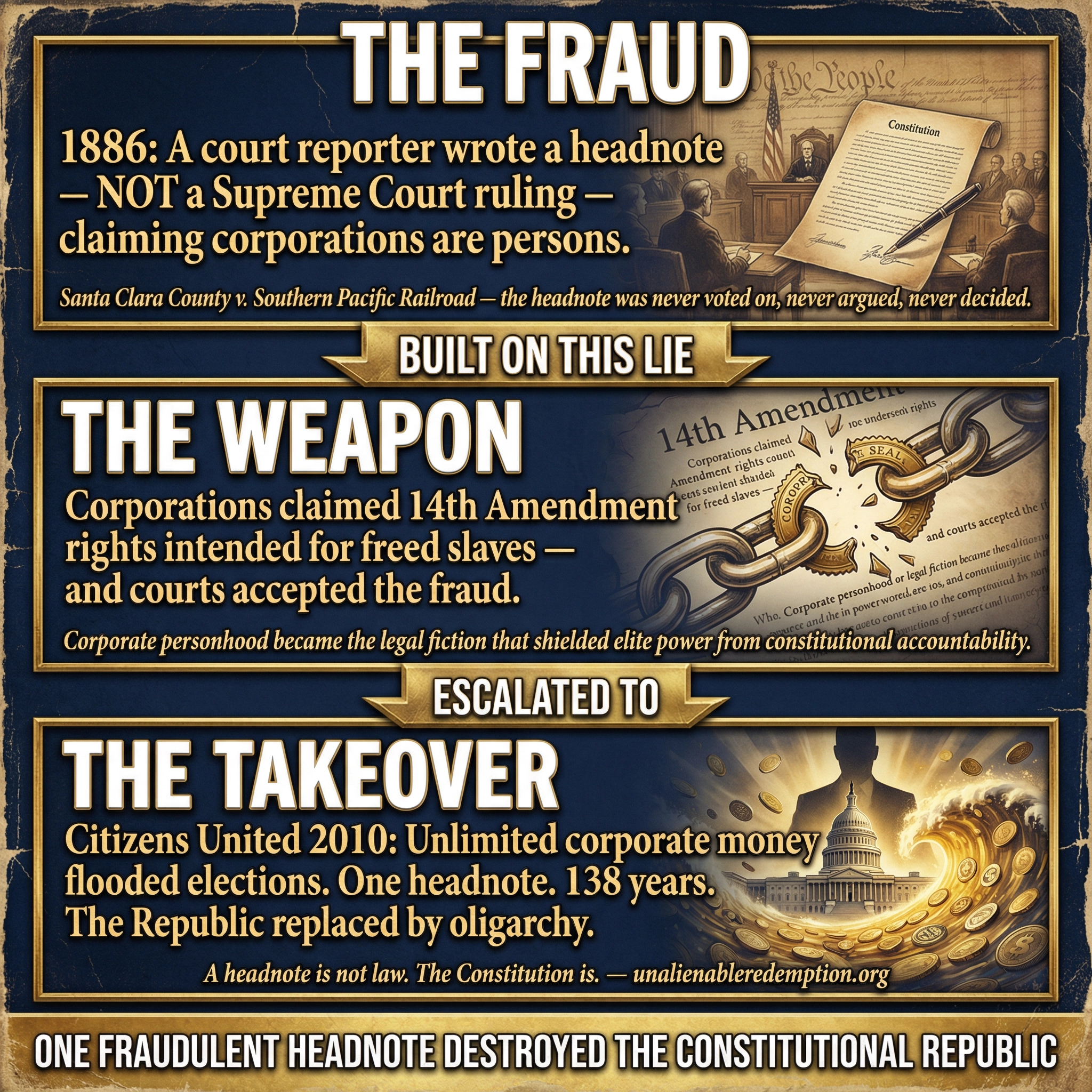
One fraudulent headnote in 1886 destroyed the Constitutional Republic. Share this and wake people up.
Get More Articles Like This
Subscribe to receive new constitutional education articles and updates.