The birth certificate system represents one of the most profound yet least understood mechanisms of constitutional subversion in American history. While the 1886 Santa Clara County decision fraudulently granted corporations the rights of natural persons, the 1933 birth certificate mandate completed the inverse transformation: converting natural persons into legal fictions subject to corporate control.
This article examines the historical timeline, constitutional violations, and practical implications of the birth certificate system—and explains why understanding this distinction is crucial for reclaiming your unalienable rights under the Constitution.
The Inverse Fraud: Two Sides of Corporate Control
1886: Corporations Become "Persons"
Santa Clara County v. Southern Pacific Railroad established corporate personhood through court reporter fraud, granting corporations constitutional rights intended for natural persons.
Result: Corporations gain constitutional protections
1933: Natural Persons Become "Legal Fictions"
Birth certificate mandate creates "legal persons" separate from natural persons, converting living men and women into corporate entities subject to statutory control.
Result: Natural persons lose constitutional protections
Together, these two frauds created a complete system of corporate control: corporations gained rights they never had, while natural persons lost protections they always possessed.
The Timeline: 1900-1933
The birth certificate system was not implemented overnight. It developed gradually over three decades, coordinated with the establishment of the Federal Reserve and other mechanisms of corporate control.
Early State Implementation
Individual states begin implementing birth registration systems, initially presented as public health measures to track infant mortality rates and improve medical care.
Federal Reserve Act
Establishment of the Federal Reserve creates the financial infrastructure necessary for securitizing birth certificates as collateral instruments.
Sheppard-Towner Act
Federal funding incentivizes states to adopt standardized birth registration systems, accelerating nationwide implementation under the guise of maternal and infant health programs.
Nationwide Mandate
Birth certificate registration becomes effectively mandatory nationwide, completing the system exactly 20 years after the Federal Reserve Act and 47 years after Santa Clara County.
Social Security Integration
Birth certificates become required for Social Security Number issuance, cementing the link between the legal person and federal benefits/taxation systems.
Natural Person vs. Legal Person: Understanding the Distinction
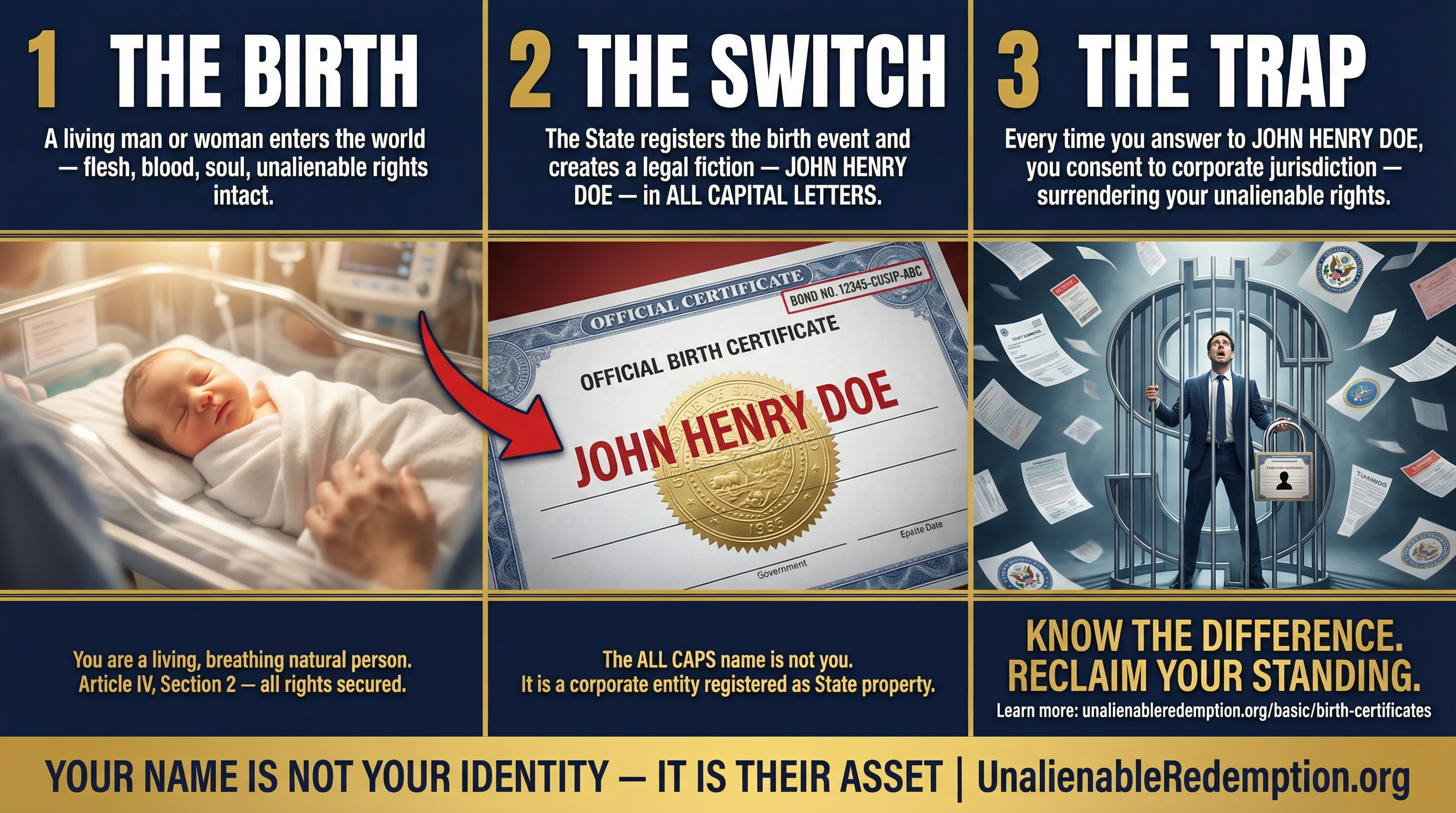
The birth certificate system creates a fundamental separation between the natural person (you, the living man or woman) and the legal person (the corporate entity created by the state). This distinction has profound implications for constitutional rights and legal standing.
| Characteristic | Natural Person | Legal Person |
|---|---|---|
| Legal Status | Living man or woman | Corporate fiction created by state |
| Rights | Unalienable rights under Constitution | Statutory privileges granted by state |
| Name Format | John Smith (proper case) | JOHN SMITH (all capitals) |
| Jurisdiction | Common law, constitutional law | Statutory law, administrative law |
| Consent Required | Yes, for all government actions | No, presumed consent via registration |
Key Point:
When you interact with government agencies using your birth certificate, you are operating as the legal person—the corporate fiction—not as the natural person protected by the Constitution. This is why government agencies can impose statutory requirements without your explicit consent.
The ALL CAPS Name: Legal Significance
One of the most visible indicators of the legal person vs. natural person distinction is the use of ALL CAPITAL LETTERS in official documents. This is not a typographical convention—it has specific legal meaning.
Examples of ALL CAPS Usage:
- • Birth certificates: JOHN MICHAEL SMITH
- • Social Security cards: JOHN M SMITH
- • Driver's licenses: SMITH, JOHN M
- • Court documents: JOHN SMITH, Defendant
- • Tax forms: SMITH, JOHN
Under legal conventions, ALL CAPS names indicate corporate entities, not natural persons. This convention appears in Black's Law Dictionary and various legal style guides. When your name appears in ALL CAPS on government documents, you are being addressed as the legal person—the corporate fiction—not as the living man or woman.
This distinction matters because the legal person can be subject to statutory requirements, administrative regulations, and corporate court jurisdiction that do not apply to the natural person protected by constitutional law.
Constitutional Violations
The birth certificate system violates multiple constitutional protections:
10th Amendment Violation
The 10th Amendment reserves to the states and the people all powers not delegated to the federal government. The Constitution grants no authority to create legal persons or convert natural persons into corporate entities.
"The powers not delegated to the United States by the Constitution, nor prohibited by it to the States, are reserved to the States respectively, or to the people."
Due Process Violation (5th & 14th Amendments)
Creating a legal person without the knowledge or informed consent of the natural person violates due process protections. Parents registering their child's birth are not informed that they are creating a separate corporate entity subject to statutory control.
Informed Consent Violation
The birth certificate registration process does not disclose the legal implications of creating a legal person, the distinction between natural and legal persons, or the rights being waived through registration. This lack of disclosure violates fundamental principles of informed consent.
Unalienable Rights Violation
The Declaration of Independence recognizes that all persons possess unalienable rights that cannot be surrendered or transferred. Converting a natural person into a legal person subject to statutory control effectively transfers these rights to the state without consent.
Practical Implications: How This Affects You
Understanding the birth certificate system has immediate practical implications for how you interact with government agencies, courts, and financial institutions.
Court Proceedings
When you appear in court as "JOHN SMITH," you are operating as the legal person subject to statutory jurisdiction. Understanding this distinction allows you to challenge jurisdiction and assert your rights as a natural person under constitutional law.
Government Benefits
Social Security, Medicare, and other federal benefits are tied to the legal person, not the natural person. Accepting these benefits creates contractual obligations that may waive certain constitutional protections.
Driver's Licenses
Driver's licenses are issued to the legal person, converting the unalienable right to travel into a statutory privilege requiring government permission and subject to suspension or revocation.
Tax Obligations
Federal income tax is imposed on the legal person through the Social Security Number system. Understanding the distinction between natural and legal persons is crucial for asserting constitutional tax protections.
Critical Warning: Avoid Sovereign Citizen Tactics
While the birth certificate system does raise legitimate constitutional concerns, many "sovereign citizen" tactics based on this knowledge are legally ineffective and can result in serious consequences.
Ineffective Tactics to Avoid:
- • Claiming you are not the "legal person" named in court documents
- • Refusing to recognize court jurisdiction based solely on ALL CAPS names
- • Filing UCC-1 financing statements to "reclaim" your legal person
- • Claiming birth certificates are securities that can be redeemed for money
- • Using "red ink signature" or "autograph" to distinguish yourself from the legal person
These tactics have been repeatedly rejected by courts and can result in sanctions, fines, or even criminal prosecution. The constitutional issues raised by the birth certificate system require systematic legal challenges through proper channels, not individual pseudo-legal maneuvers.
The Path Forward: Constitutional Restoration
Addressing the birth certificate system requires systematic constitutional restoration efforts, not individual attempts to "opt out" of the system. The solution lies in collective action to restore constitutional governance.
Education and Awareness
Understanding the birth certificate system and its constitutional implications is the first step. Share this knowledge with others to build awareness of how corporate control mechanisms operate.
Enforce Prerequisites to Office
Challenge government officers who lack proper constitutional oaths and bonds. Officers without proper prerequisites lack lawful authority to enforce statutory requirements on natural persons.
Challenge Corporate Personhood
The birth certificate system is the inverse of the 1886 corporate personhood fraud. Both must be challenged together to restore constitutional governance.
Systematic Legal Challenges
Constitutional violations must be challenged through proper legal channels with well-researched arguments, not through individual pseudo-legal tactics that courts have repeatedly rejected.
Learn More About the Birth Certificate System
This article provides an introduction to the birth certificate system and its constitutional implications. For deeper analysis, including detailed legal frameworks, case law, and constitutional restoration strategies, explore our comprehensive resources.
Spread the Truth
Share This With Everyone You Know
Most people have never been told what their birth certificate actually is. Help change that.
Property of Golden Spiral Ministries — All Rights Reserved
Related Content
The 1886 Corporate Personhood Fraud
How a court reporter's fraudulent headnote granted corporations constitutional rights.
Read Article →Prerequisites to Office
Constitutional oath and bond requirements that officers must meet to have lawful authority.
Learn More →Republic vs. Democracy
Understanding America's true form of government and why the distinction matters.
Explore Topic →