The President Has No Authority to Fire Foreign Leaders — Or Domestic Officers Without Cause
The same constitutional principle that prohibits the President from demanding a foreign leader's resignation also prohibits the removal of domestic officers without lawful cause. Understanding this principle is essential to recognizing executive overreach at every level.
Current Events Context
In March 2026, President Trump reportedly demanded the resignation of Canadian Prime Minister Mark Carney — an assertion of executive authority that generated widespread commentary about the constitutional limits of presidential power. This analysis uses that event as a launching point to examine the same overreach pattern as it operates domestically against natural persons.
Note: Mainstream commentary on this event frames the issue through international norms and postwar institutional arrangements. This analysis frames it exclusively through the de jure constitutional framework — the original Constitution and the Statutes at Large — which is the only lawful standard of authority.
What Article II Actually Grants
The Constitution vests the executive power in the President under Article II, Section 1. The specific foreign policy powers enumerated are narrow and precisely defined. The President is Commander in Chief of the military — not a commander of foreign governments. The President negotiates treaties — with the Senate's consent. The President appoints and receives ambassadors — a recognition function, not a removal function.
There is no enumerated grant of authority for the President to demand the resignation of a foreign head of state. The principle operating here is foundational to the entire constitutional framework: the executive possesses only what is expressly granted. Everything not granted to the federal government is reserved to the states or to the people themselves — Tenth Amendment, plain text.
This is not a technicality. It is the structural principle that separates a constitutional republic from an empire. When the executive asserts authority beyond its enumerated grants — whether over a foreign prime minister or a domestic officer — it is operating under color of authority, not lawful constitutional authority.
The Same Pattern Operates Domestically
The demand for a foreign leader's resignation is the international face of an overreach pattern that operates every day at the domestic level — and it directly affects natural persons. The constitutional principle is identical: the executive may remove officers only where the Constitution or a lawful statute expressly authorizes removal, and only for cause consistent with that authorization.
The Supreme Court established this principle in Humphrey's Executor v. United States (1935): Congress may create independent agencies whose officers are protected from removal except for cause. The President's removal of Rebecca Kelly Slaughter from the Federal Trade Commission without statutory cause — litigated in Trump v. Slaughter — is the direct domestic equivalent of demanding a foreign leader's resignation. Both assert a power to remove that is not constitutionally granted.
More broadly, the same overreach pattern appears wherever the executive branch asserts authority it does not constitutionally possess:
- →Executive Orders that purport to create law without congressional delegation — Article I, Section 1 vests all legislative power in Congress, not the President.
- →Emergency declarations that suspend constitutional protections without the specific enumerated grants required — emergency powers are Article I powers, meaning Congress determines their scope and duration, not the Executive.
- →Regulatory agency actions that exceed the statutory delegation from Congress — an agency can only act within the authority Congress lawfully granted, and Congress can only grant what the Constitution grants to Congress.
- →Officers acting without oath and bond — the prerequisite to office established in Article VI, Clause 3 means an officer who has not taken and filed a lawful oath, and posted the required bond, is not a lawful officer. Their actions carry no constitutional authority regardless of what title they hold.
Congress Holds the Constitutional Check — When It Chooses to Use It
Commentary on the Canada situation correctly identifies that Congress holds the constitutional authority to constrain executive foreign policy overreach. This is consistent with the original constitutional design: Article I, Section 8 grants Congress the power to regulate commerce with foreign nations, define and punish offenses against the law of nations, and declare war. The Advice and Consent requirement for treaties and ambassador appointments places Congress as a co-equal check on executive foreign policy.
The same congressional check applies domestically. Congress holds the power of the purse (Article I, Section 9), the power to create and define the jurisdiction of executive agencies, and the power to impeach. These are not theoretical powers — they are the constitutionally designed mechanisms for restraining executive overreach.
The critical observation for platform members is this: the fact that Congress often fails to exercise these checks does not mean the executive has acquired new constitutional authority. An unenforced constitutional limit remains a constitutional limit. The failure of Congress to act creates a de facto expansion of executive power — but it does not create a de jure grant of authority. Natural persons retain the right to challenge actions taken under color of authority that exceeds the constitutional grant, regardless of whether Congress has acted to restrain that overreach.
Actions Beyond Constitutional Authority Are Void From Inception
The constitutional framework provides a clear remedy for actions taken beyond enumerated authority: they are void ab initio — void from inception, as if they never occurred. This is not a modern invention. It is the direct application of the principle established in Marbury v. Madison (1803): an act repugnant to the Constitution is void.
Applied to the overreach pattern: an executive order that exceeds the President's enumerated authority is void. A regulatory action that exceeds the statutory delegation from Congress is void. An officer's action taken without a lawful oath and bond is void. A demand for a foreign leader's resignation carries no constitutional force because there is no constitutional grant of authority to make it.
This principle is the foundation of the platform's Presidential Overreach module and the broader constitutional restoration framework. Understanding that actions beyond constitutional authority are void — not merely voidable, but void — is the key to recognizing both the nature of the overreach and the nature of the remedy available to natural persons who are directly affected by it.
Key Constitutional Principles
Enumerated Grants Only
The executive possesses only what Article II expressly grants. All other power is reserved to Congress, the states, or the people.
Void Ab Initio
Actions beyond constitutional authority are void from inception — not merely challengeable, but constitutionally non-existent.
Congress Holds the Check
Article I grants Congress the tools to restrain executive overreach. Congressional inaction does not create new executive authority.
Oath & Bond Prerequisites
Article VI, Clause 3 requires officers to take and file a lawful oath and post the required bond before any action carries constitutional authority.
Go Deeper on Presidential Overreach
The Presidential Power Overreach module provides the full constitutional analysis of Trump v. Slaughter, Trump v. Illinois, the unitary executive theory, and the void ab initio doctrine — with practical enforcement strategies for natural persons directly affected by overreach at every level.
Spread the Truth
Share This Meme — Article II Enumeration Principle
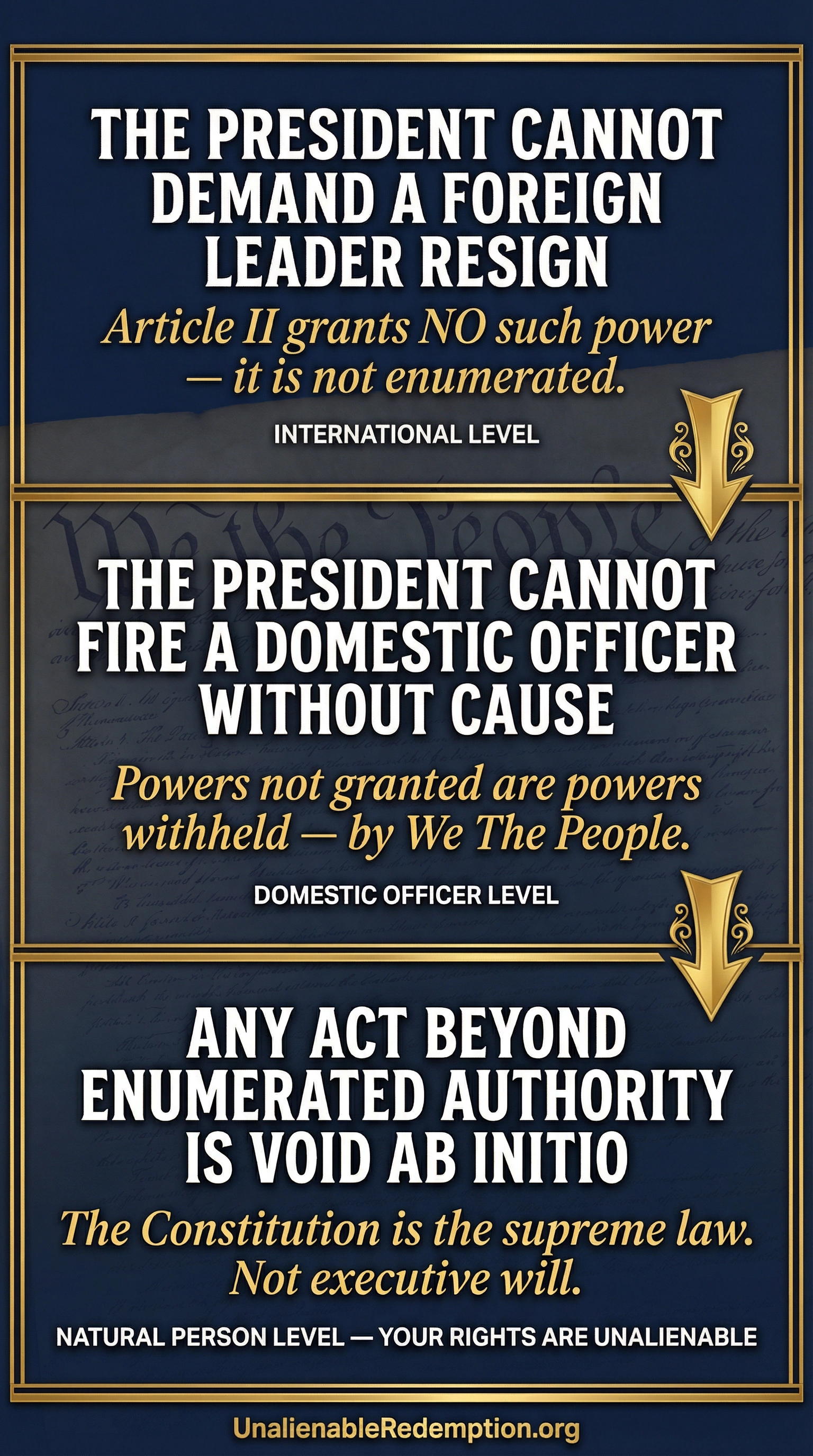
Share This Analysis
The same constitutional principle that bars the President from firing a foreign leader bars removal of domestic officers without cause. Share this analysis.
Related Content
Presidential Power Overreach: Trump v. Slaughter & Trump v. Illinois
Full constitutional analysis of the unitary executive theory
Trump SCOTUS Cases — BASIC Overview
Plain-language introduction to the key Supreme Court cases
Accountability Mechanisms — Separation of Powers
How the constitutional framework is designed to check executive overreach
Prerequisites to Office — Oath & Bond Requirements
Article VI, Clause 3 and the vacancy created by non-compliance
Private Property of Golden Spiral Ministries — All Rights Reserved